Basically, all of the links on this page are affiliate links. I receive a commission (at no extra cost to you) if you make a purchase after clicking one of the affiliate links below. Read our Affiliate Link Policy for more information.
Parts I used
- Buy the Sequre BKLi 10 at the Sequre Store
I used to consider myself pretty freaking lucky if I could get a 5-inch freestyle bind-and-fly for less than about $300. So when I saw that Sequre sells a 10-inch bind-and-fly, the Sequre BKLi 10, for under $300, my first thought was: how good could it possibly be? Surely they’ve cut a whole bunch of corners, it’s a piece of crap, and they’re just trying to sell it to people who want to pay the least amount of money possible and don’t know or don’t care that the quality sucks. Then I thought, that’s hardly fair. Why don’t I just get one and see how good it is?
I don’t want you to think of this as a review that tells you whether it’s a good 10-inch compared to other 10-inch bind-and-flies. There just aren’t a lot of 10-inch bind-and-flies out there to compare it to. What I want to do is answer the question that made me get this drone in the first place: how freaking good could it be? The short answer is that it’s pretty freaking good.
Build quality and workmanship are excellent
In terms of build quality and workmanship, I’m very impressed. The wires are neatly tucked and neatly dressed. The capacitor is zip-tied to the XT60, so it’s not flapping around and breaking off. The solder joints look great. The video transmitter is nicely mounted, running out to the SMA connector on the end, and the SMA connector is good and tight. They properly tightened it so it doesn’t twist or spin.
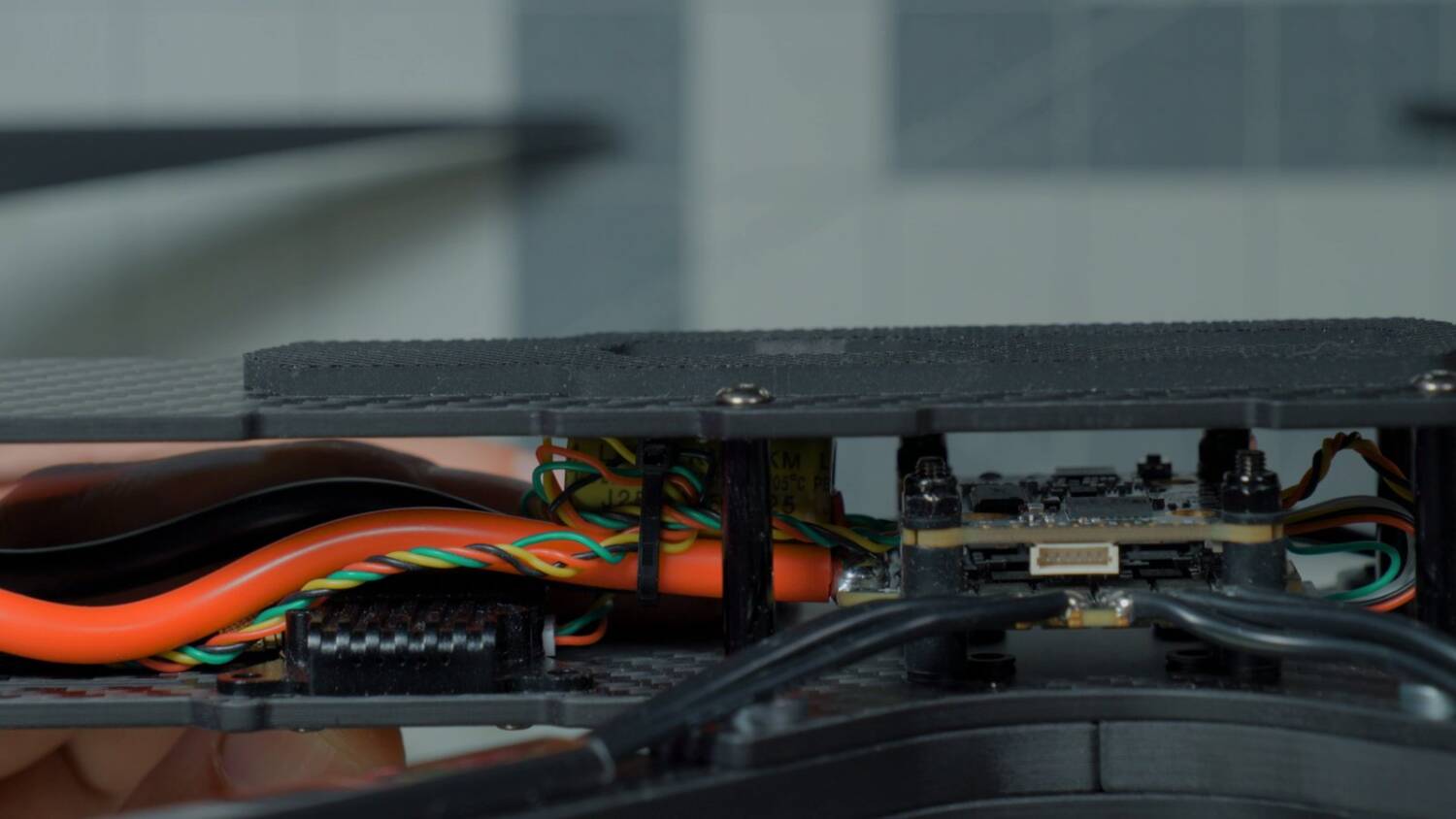
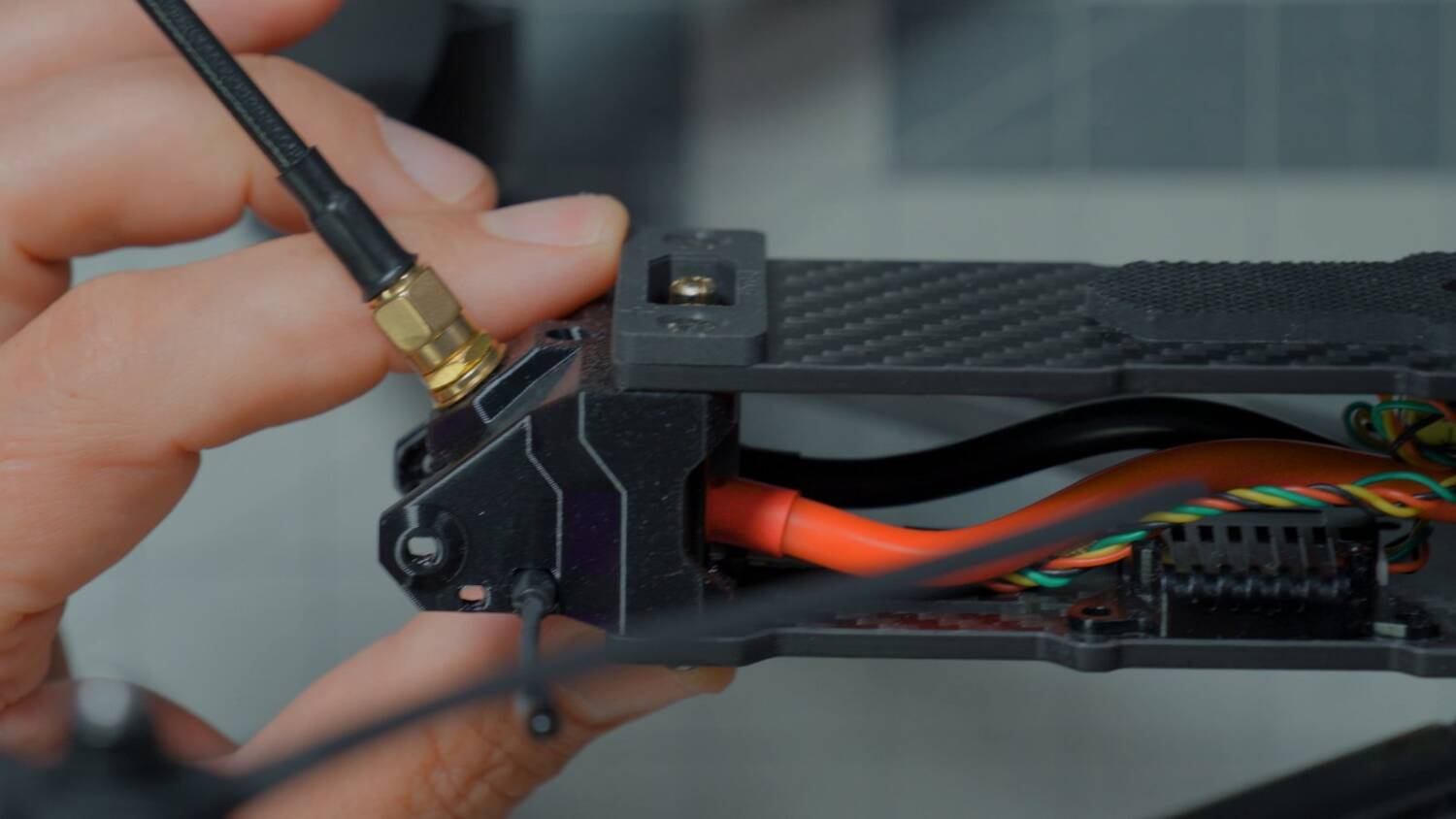
There are so many little things done in this build that I look at and go: if this were made to the absolute lowest possible price point, they would have skipped this. And they didn’t.
H743 FC supports Betaflight, INAV and ArduPilot
With the top plate off, we get a closer look at the flight controller: the Sequre H743 V2. I’m not going to read you the whole spec sheet, but it ticks a lot of the boxes you’d look for. The processor is the H743, and among other things, that means it has Betaflight, INAV and ArduPilot targets.
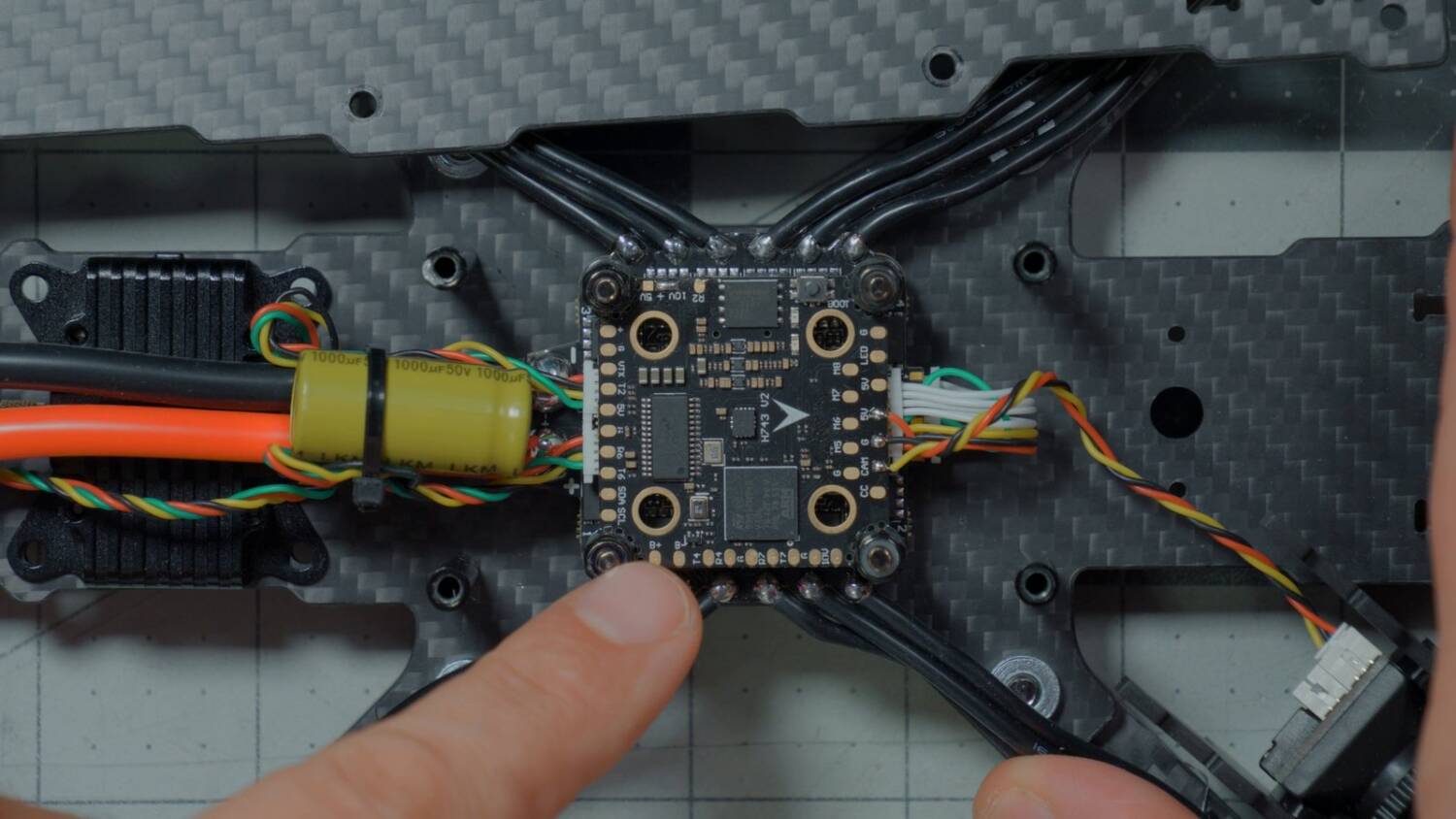
A lot of people with these larger drones start thinking about longer-range stuff, and they’ll want to put ArduPilot on, because it has better autonomous flight capabilities and better functionality for long range. It’ll integrate with a ground station, for managing the flight when you’re not necessarily looking through the goggles. And it integrates better with advanced sensors like lidar, optical flow, even companion computers like a Raspberry Pi. If you want to do all that stuff, you can put ArduPilot on this flight controller.
8S-rated FC and ESC
The flight controller and ESC are both rated up to 8S. Some people like to run 8S on even smaller drones. I built an 8S 5-inch, and it completely ripped, but that’s more of a novelty than it is practical. As you get into larger props, and I feel like 8 to 10 inches is the smallest prop size where 6S starts to show its limitations a little, it starts to make sense to go to higher-voltage batteries.
Since the flight controller and ESC are ready to go on 8S, you could swap in an 8S battery. The motor KV is tailored for 6S, so you’d need to make some adjustments there, but you could use an 8S battery with this if you wanted to. The flight controller has all the voltage regulators and UARTs you’d want for all the peripherals you’d want.
70A ESC with AM32
The ESC is rated for up to 70 amps. Who knows what that number means? We’re not doing thermal testing. But it’s a 70 amp rated ESC, so presumably it’s fine with these motors.
It runs AM32 firmware. Sequre’s web page says BLHeli_32 / AM32. I’d guess that in this day and age they’re shipping it with AM32, and I’d prefer that, because BLHeli_32 is discontinued and can be a hassle: you can’t flash it, and configuring it is sometimes a hassle too.
vTX rated for 1.6 watts
The video transmitter is rated for 1.6 watts. That’s fine for the kind of flights you’d typically do with a 10-inch drone. Some people would want more power. They’d say, “This is clearly long-range focused,” setting aside the question of whether long range is even legal for you to do, “so you’d want as much power as possible.” And you’re not wrong. I’d take more power if they gave it to me.
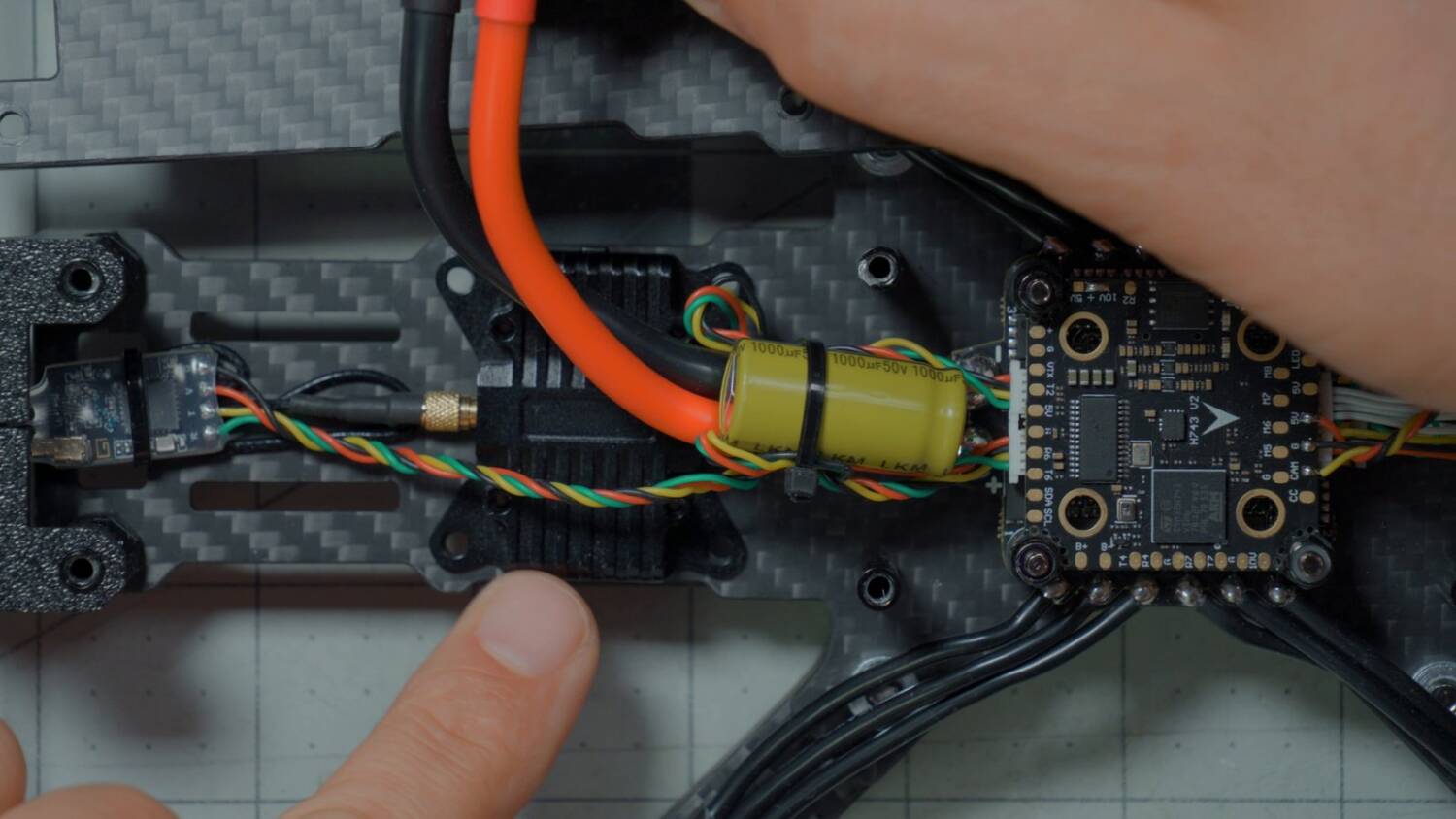
But keep in mind that going from 1.5 watts to 3 watts is a doubling of power, and that gives you about 40% more range, all else being equal. That’s not nothing, but it’s not a massive increase either. A lot of people would argue you can get done what you need to on 1.6 watts, and just get higher-gain antennas if you need more range.
I like the nice MMCX connector, with a cable running out to the SMA. It’s maybe not the best thing in the world to run that cable right under the receiver, but it’s probably fine. We’ll see if the video picks up any electrical or RF noise from the receiver.
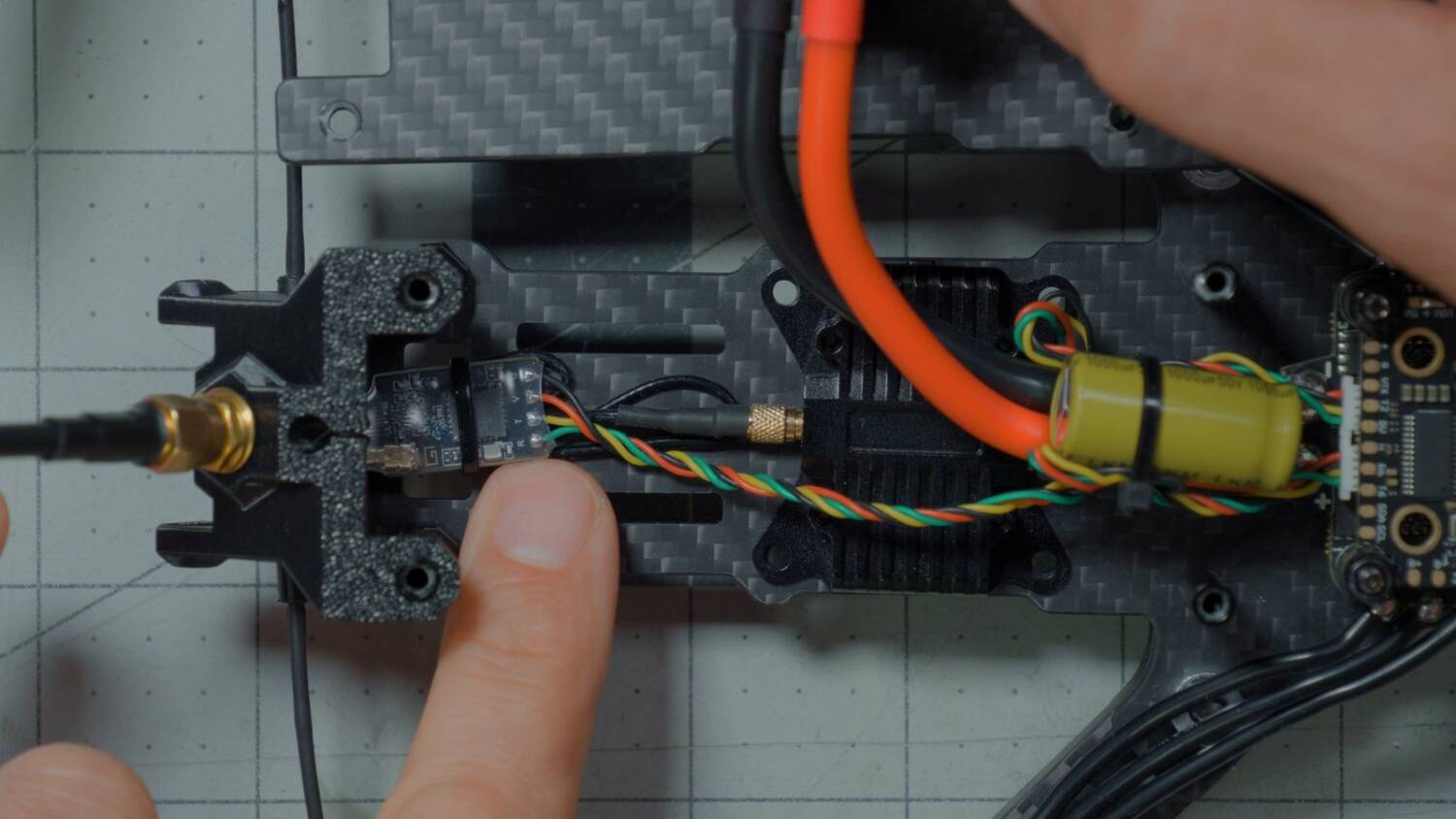
vTX power is lower than advertised
To check the output power of the video transmitter, I used the ImmersionRC RF Power Meter. It was made for a little while a few years ago, and I don’t think it’s still made. It’s meant to be an inexpensive way of very roughly measuring a vTX’s output power. It’s trying to approximate a $5,000 or $10,000 RF tool for under $100, so it’s not as accurate, but it gets you in the ballpark. So if it’s a little off, don’t read too much into it. But it tells us if we’re wildly off.
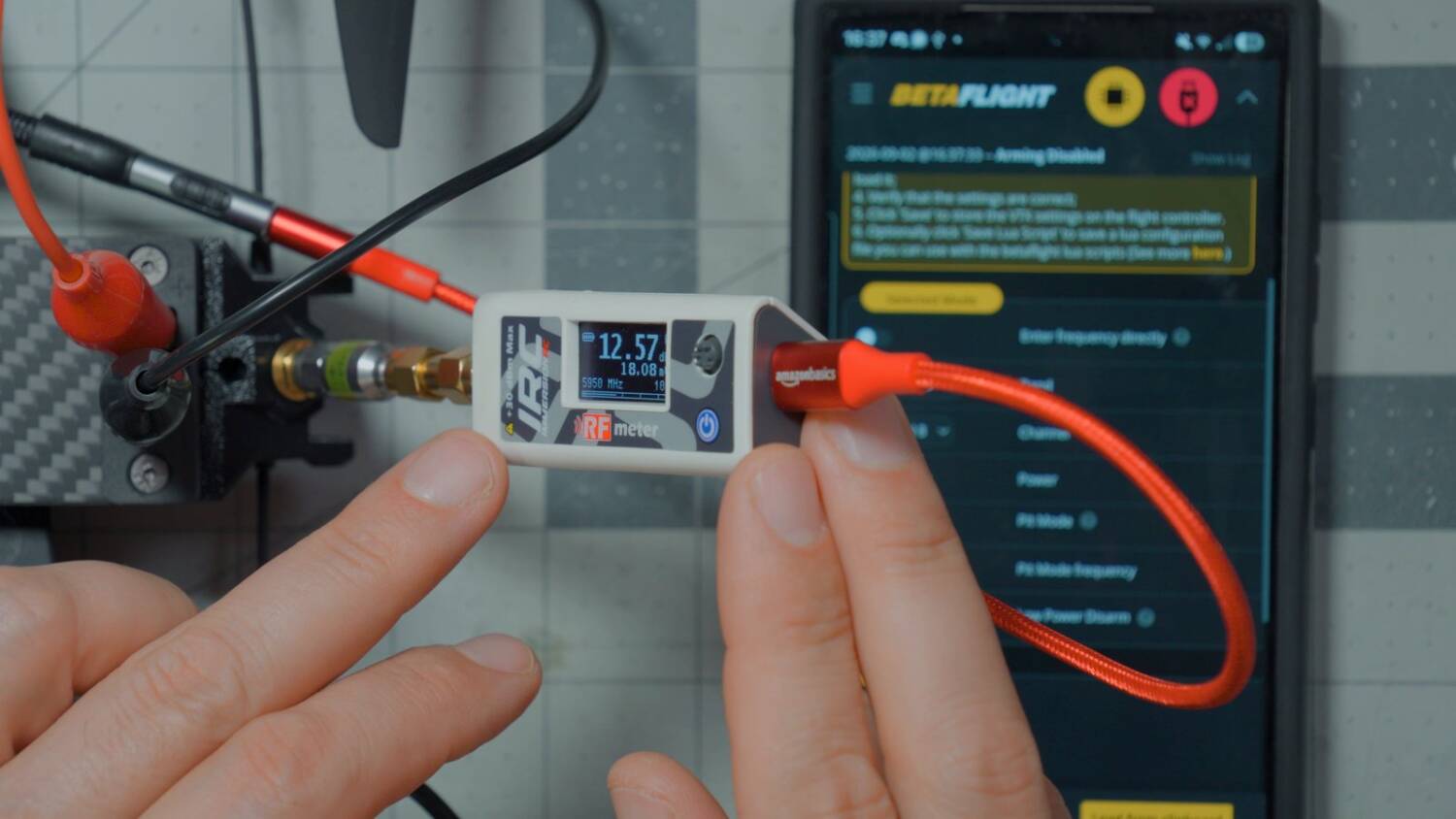
Here’s what I measured, starting on channel Race 8. (Before anyone who knows this meter says, “Whoa, Bardwell, you can’t go over 1 watt or you’ll damage it”: I had an attenuator in line, and the meter was compensating for it. I also turned off low power disarm, because we definitely wanted full power.)
- Set to 25mW: about 18mW. In the ballpark of correct.
- Set to max, 2.5 watts: about 1.5 watts. (There was a fan blowing on it, so heat buildup wasn’t an issue.)
- Set to 1.5 watts: about 600mW.
- Without the attenuator, in case it was throwing off the values, set to 800mW (as high as the meter can go without damage): roughly 300mW. Nowhere close.
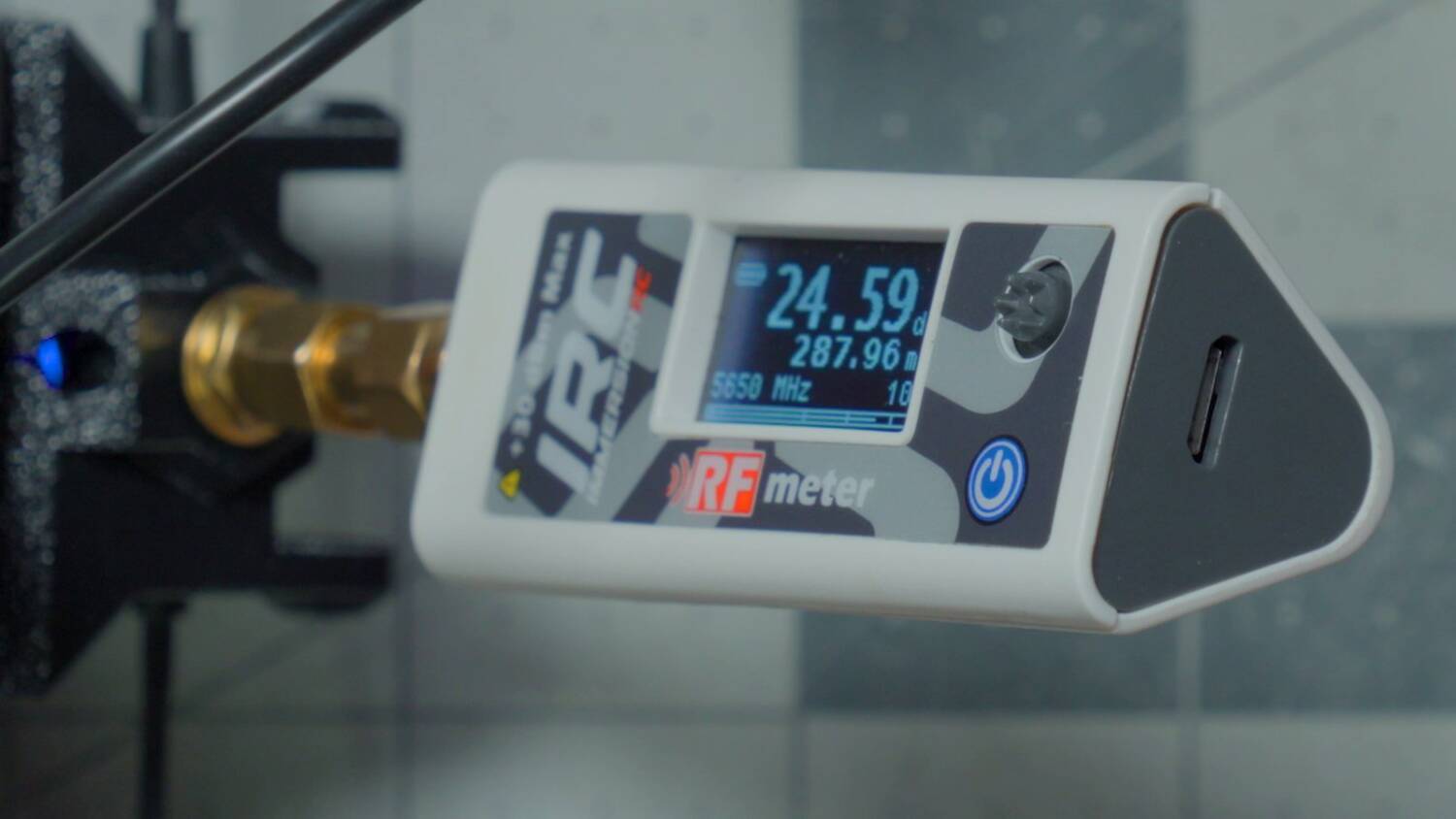
Although this is only a rough metric, I’ve used it on a lot of other video transmitters, and the numbers are usually closer than that. Without being too specific, I think we can safely conclude that this video transmitter isn’t making the output it says it’s making. I’m seeing numbers between about a quarter and a half of what it says, except at 25mW, where it was pretty close.
You could argue that maybe the vTX is putting out the right amount and the MMCX cable is losing some power. To which I’d say: if you’re losing 3 to 6dB in the MMCX cable, that’s a defective cable, and it’s your fault for shipping it that way. But I don’t find that argument very plausible. So there you go. Maybe you replace it with a better vTX, with all that money you saved.
900MHz ELRS receiver
The receiver is Sequre’s 900MHz ExpressLRS receiver. It works on either 915MHz or 868MHz, depending on your region, and it has 50mW of telemetry transmit power. That’s relevant because on long-range drones, telemetry sometimes isn’t just used to tell you your battery voltage. It’s used for things like MAVLink communication with a ground station. That’s more an ArduPilot thing than a Betaflight thing, but if you get into that world, you want higher transmit power on the telemetry.
The standard I’ve seen for most long-range receivers is 100mW, so this is half that. Keep in mind, though, that telemetry range is significantly better than you’d expect, because telemetry is a very low-bandwidth transmission, so a lot of times you’ll get fine range on 50mW. But if you really are doing MAVLink stuff, you want the highest power you can get, to match your outbound transmission power. Some devices even have 1 watt of telemetry power. So 50mW is okay, but it’s not the best you’d want for ArduPilot and MAVLink ground station stuff.
XT90 battery connector: annoying!
The battery connector, annoyingly, is an XT90. I say annoyingly because I don’t have any batteries with an XT90 on them, and most everybody I know who flies 10-inch flies it on XT60s. Yes, theoretically those big 10-inch motors could pull 200 amps or something, but in reality they don’t, especially because you’re not just leaving it at full throttle all the time.
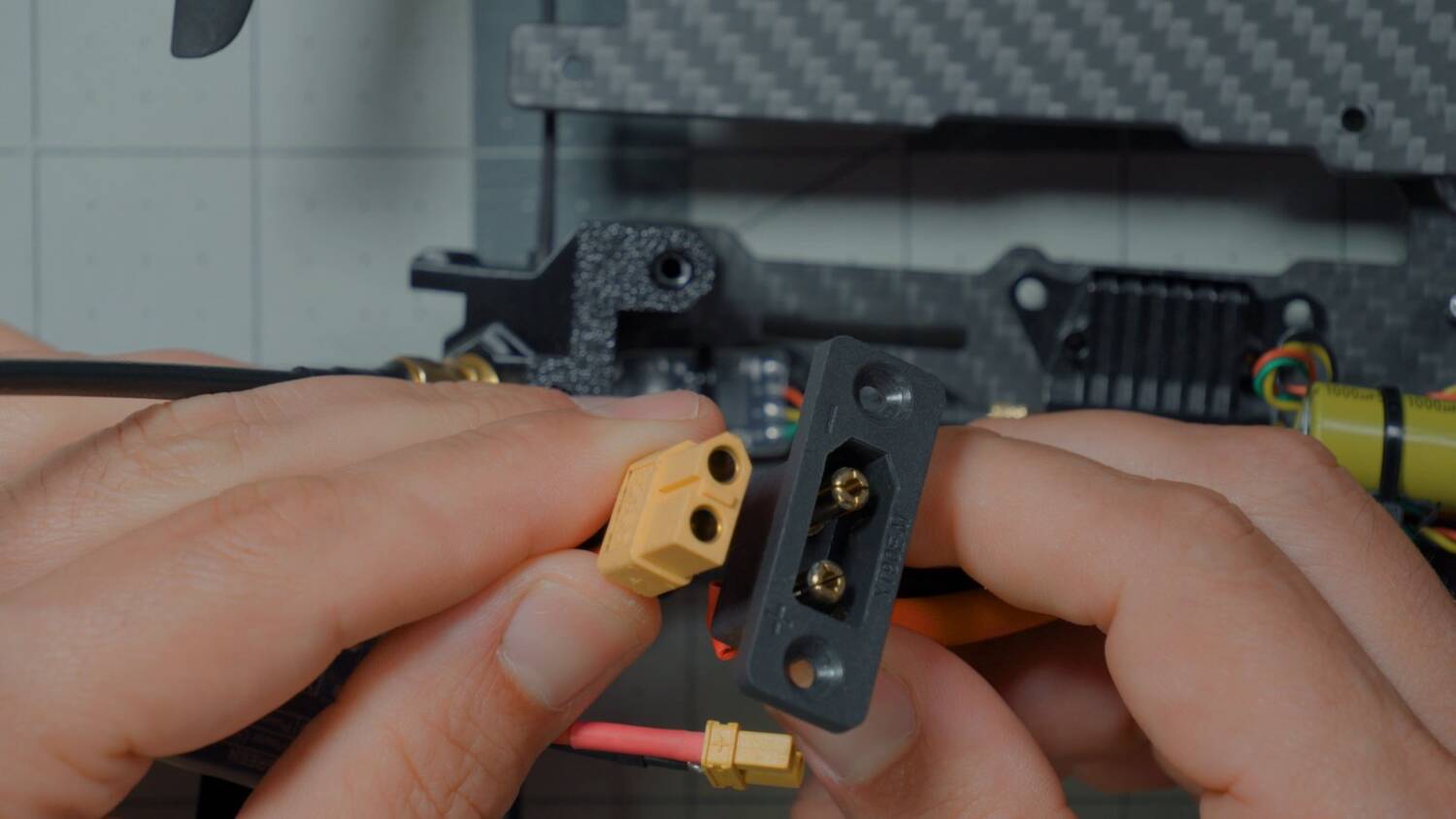
It’s not bad that they’ve done this. It’s fine. I’m just going to buy an XT90 to XT60 adapter and run an XT60 battery on it. But it did mean I couldn’t take it out and fly it the day I got it. Thanks to the power of editing, you don’t have to wait.
No GPS included
Sequre doesn’t sell this drone with a GPS, but they do have a 3D print for a GPS mount. You’ll just have to pay your own money and add the GPS yourself. So be it.
Pretty standard “school bus style” frame
There’s not a lot to say about the frame. It’s a pretty standard school-bus-style frame: a bottom plate, a top plate, and arms that strap onto the bottom. I like that it’s roomy. On these bigger drones, you’ll often want to fit an oversized video transmitter, or other equipment like that Raspberry Pi, an advanced sensor or an additional camera. Having a lot of extra room for that is certainly appreciated.
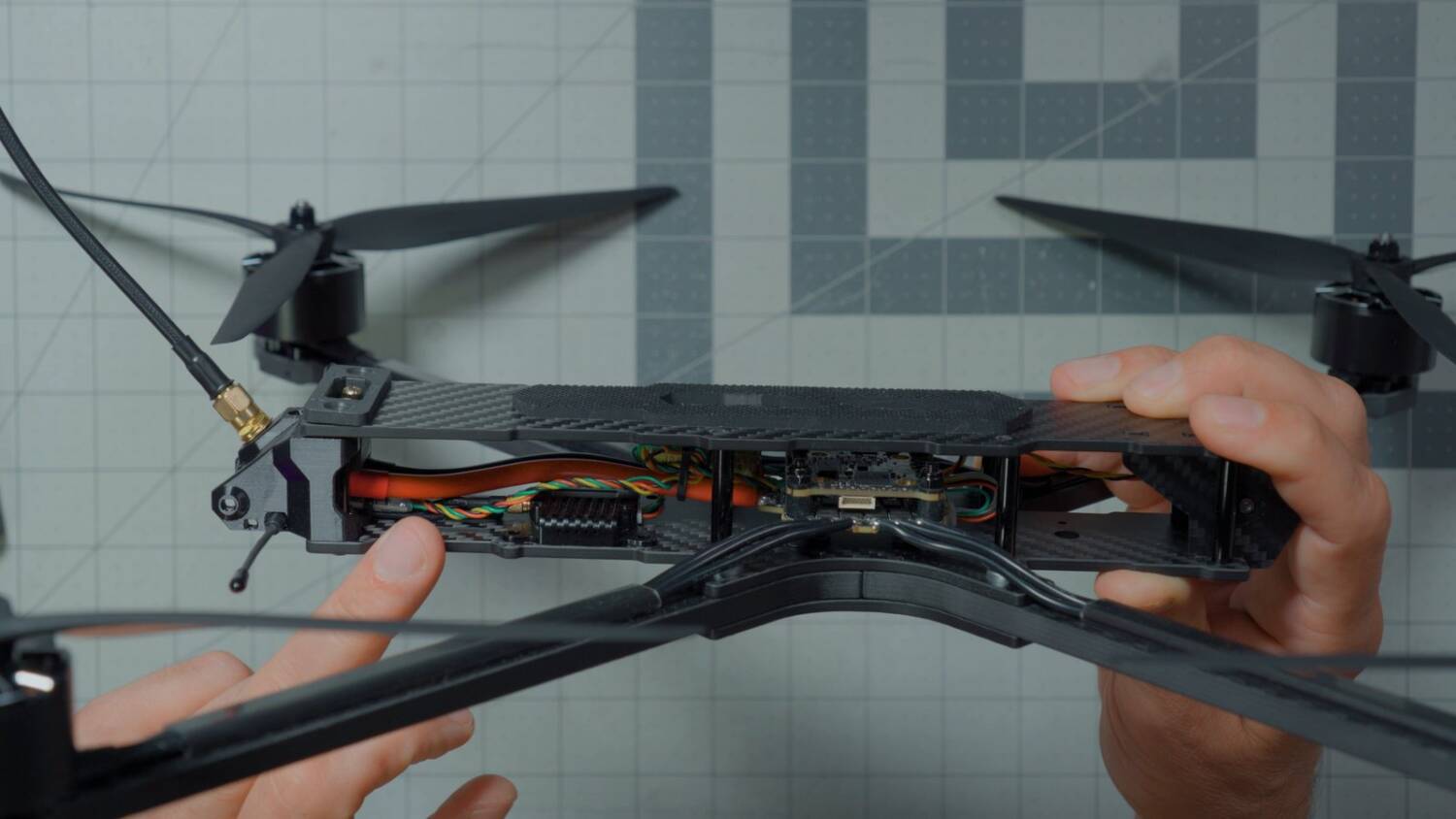
The big question is how it flies. Your priority is either smooth, vibration-free video because you’re doing cinematic stuff, or acro performance because you’re doing more agile stuff, and you’ll evaluate this frame a little differently depending on which. Drones in this size class put a lot of effort into the arms, because big, long arms sticking out can pick up resonance and vibration. You can’t judge that just by looking, and I’m not going to.
The arms are 7mm, a little thicker than the 6mm you’d commonly find on smaller drones. There’s not a lot of engineering here. It’s just a 7mm-thick length of carbon. So the question is just whether that’s thick enough to keep the vibrations from getting to the camera.
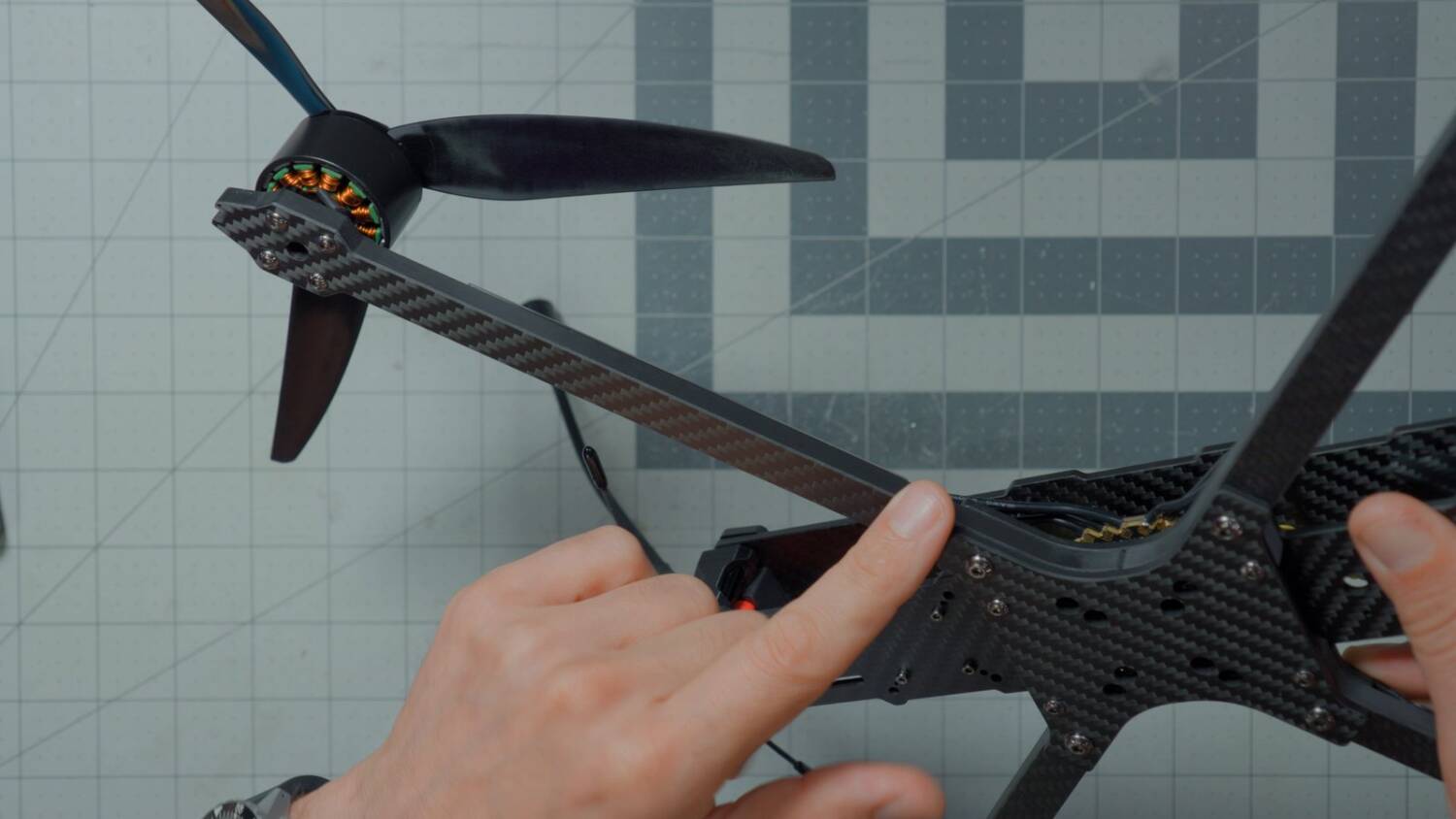
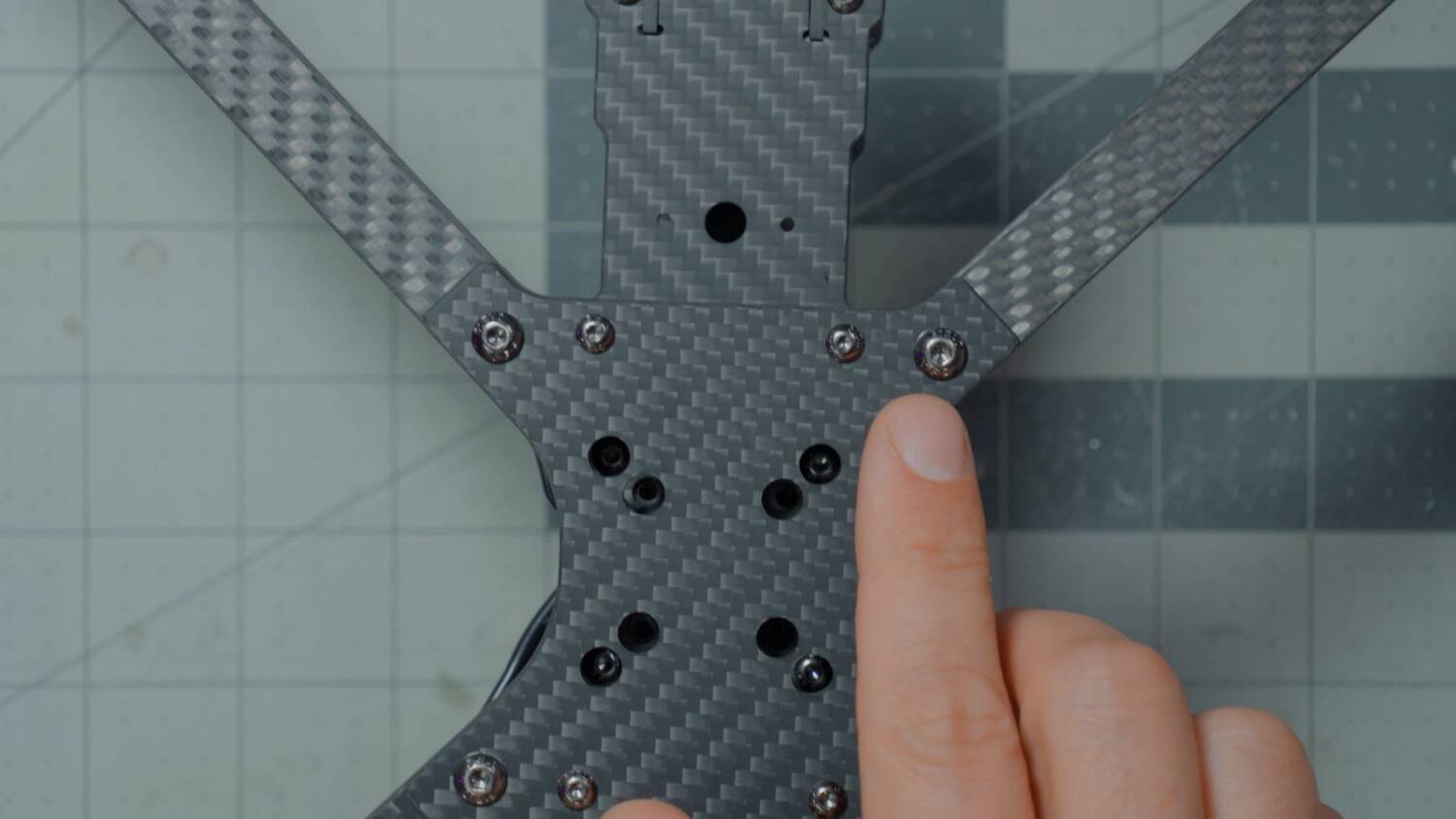
The arms are held in with two screws, which makes changing a broken arm easier. And the stack screws for the flight controller don’t engage with the arms. So if you need to take out a stack screw to work on the flight controller stack, you don’t have to take the arms apart, and if you have to change an arm, you don’t have to pull a stack screw. It always drives me crazy when frame manufacturers do that.
Motors: 3115, 900KV
Finally, the motors. There’s no printing on them whatsoever to tell you this, but they’re 3115 size and 900KV, which is absolutely bog standard for 10-inch props on a 6S battery. That’s as white bread as you can get, and that’s what you want to see. Don’t push any limits. Just give me something I know is going to work.
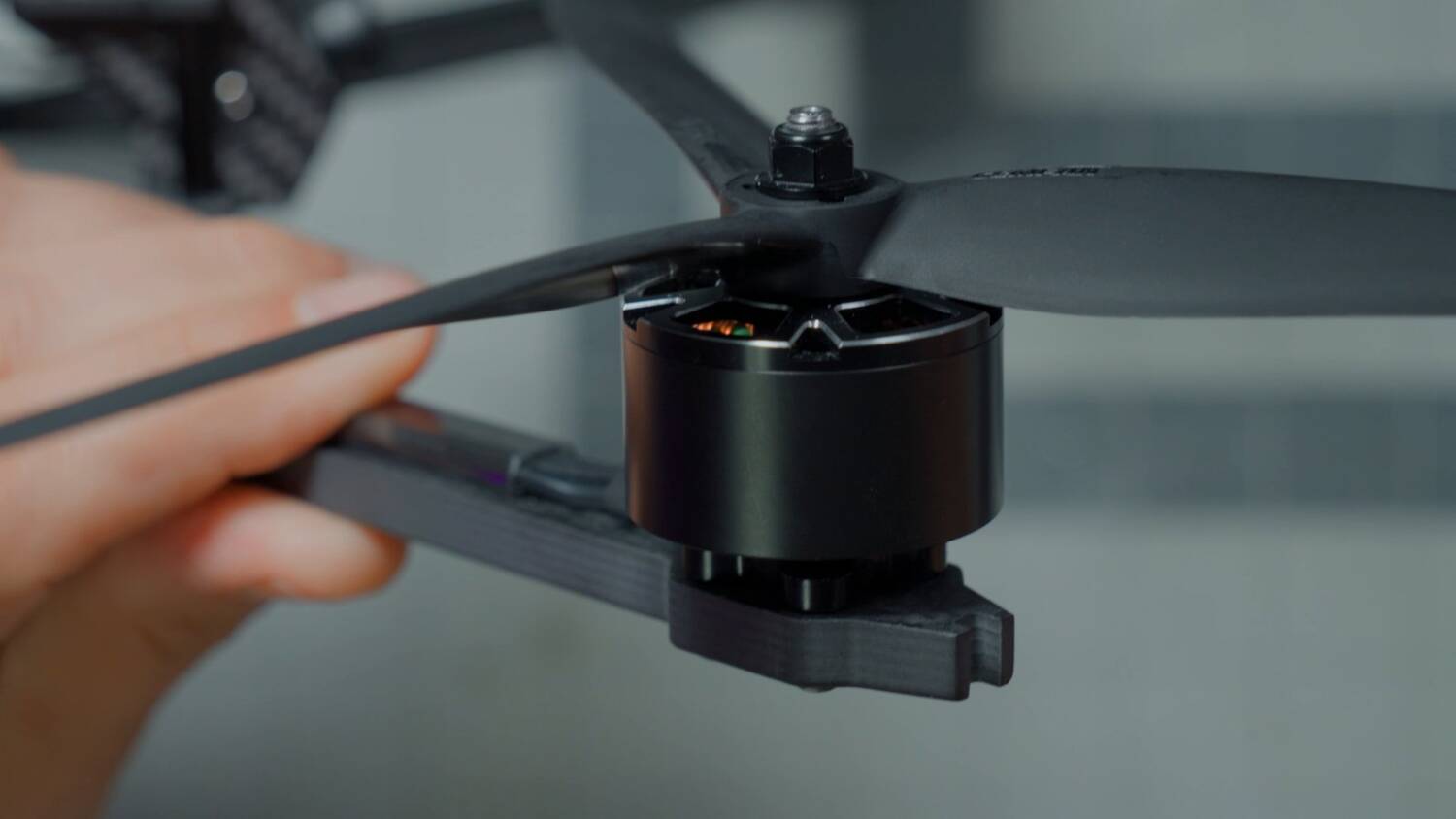
Name-brand Gemfan props
The props are even name-brand Gemfan props. They’re cutting no corners here.
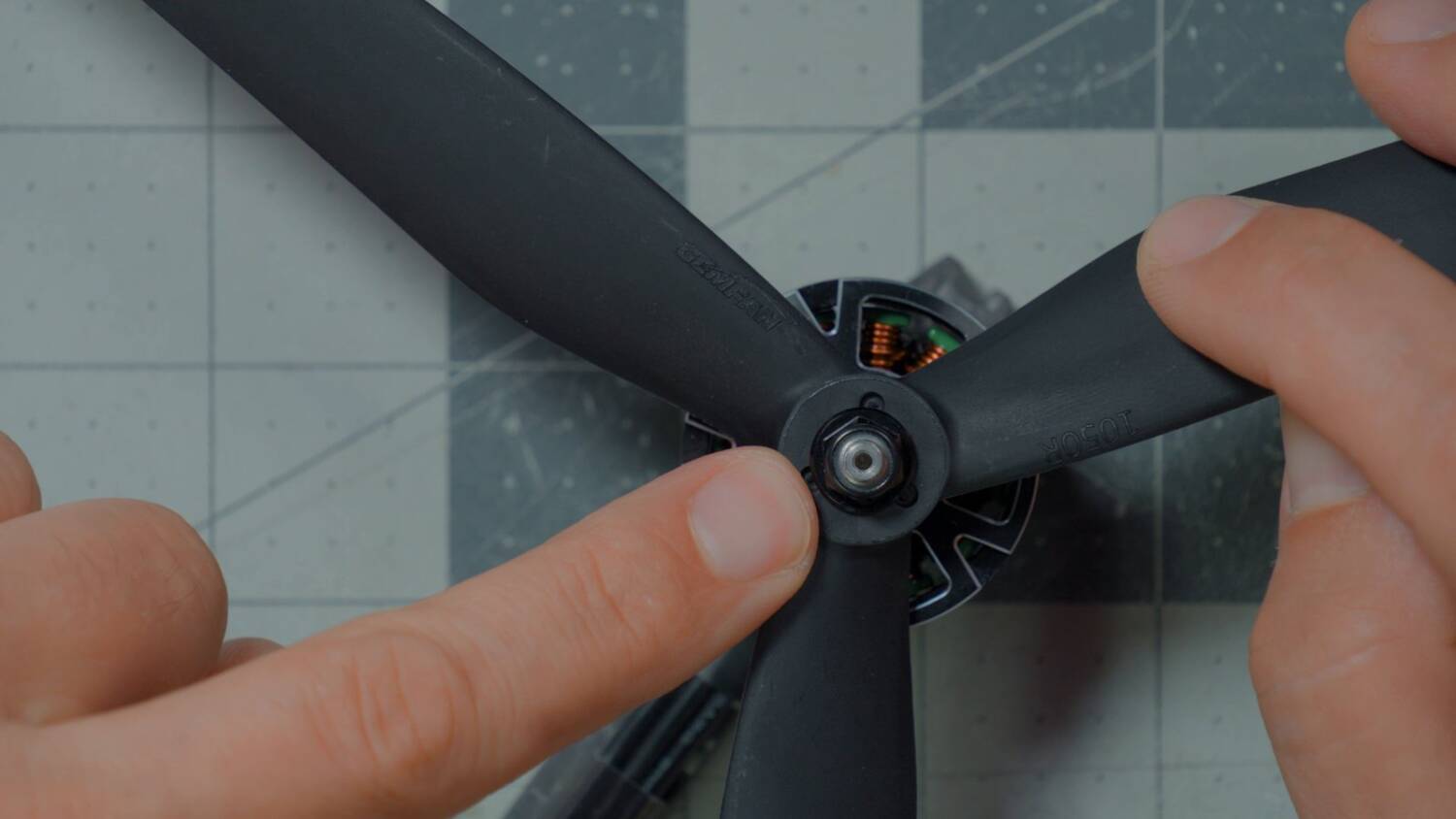
If I did have one complaint about the props, it’s that I would include washers. Look how much engagement the nut has with the prop: some, but not a lot. I’ve seen people grind them down real tight and the nut digs into the prop, or the prop has so much torque that it spins loose, not really in flight, but more in an impact. I usually like to see washers on 10-inch props. I’ll probably add them, and there are plenty of threads on top to do that.
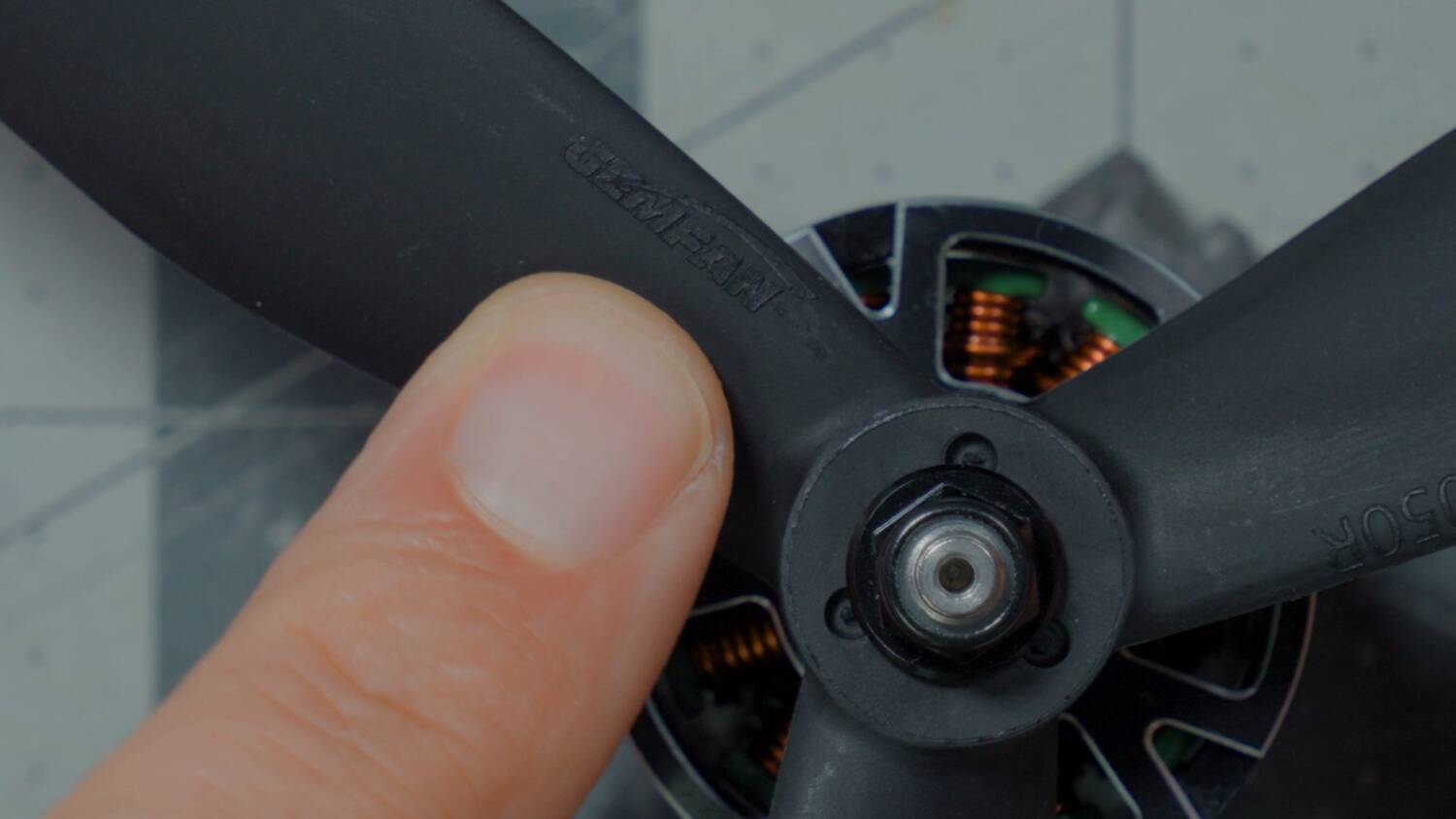
How do I know exactly what torque to set to get these nuts properly tight? I made a video about it. It’s a number of inch-pounds: I actually measured the torque of a properly torqued prop nut. Only super nerds need apply.
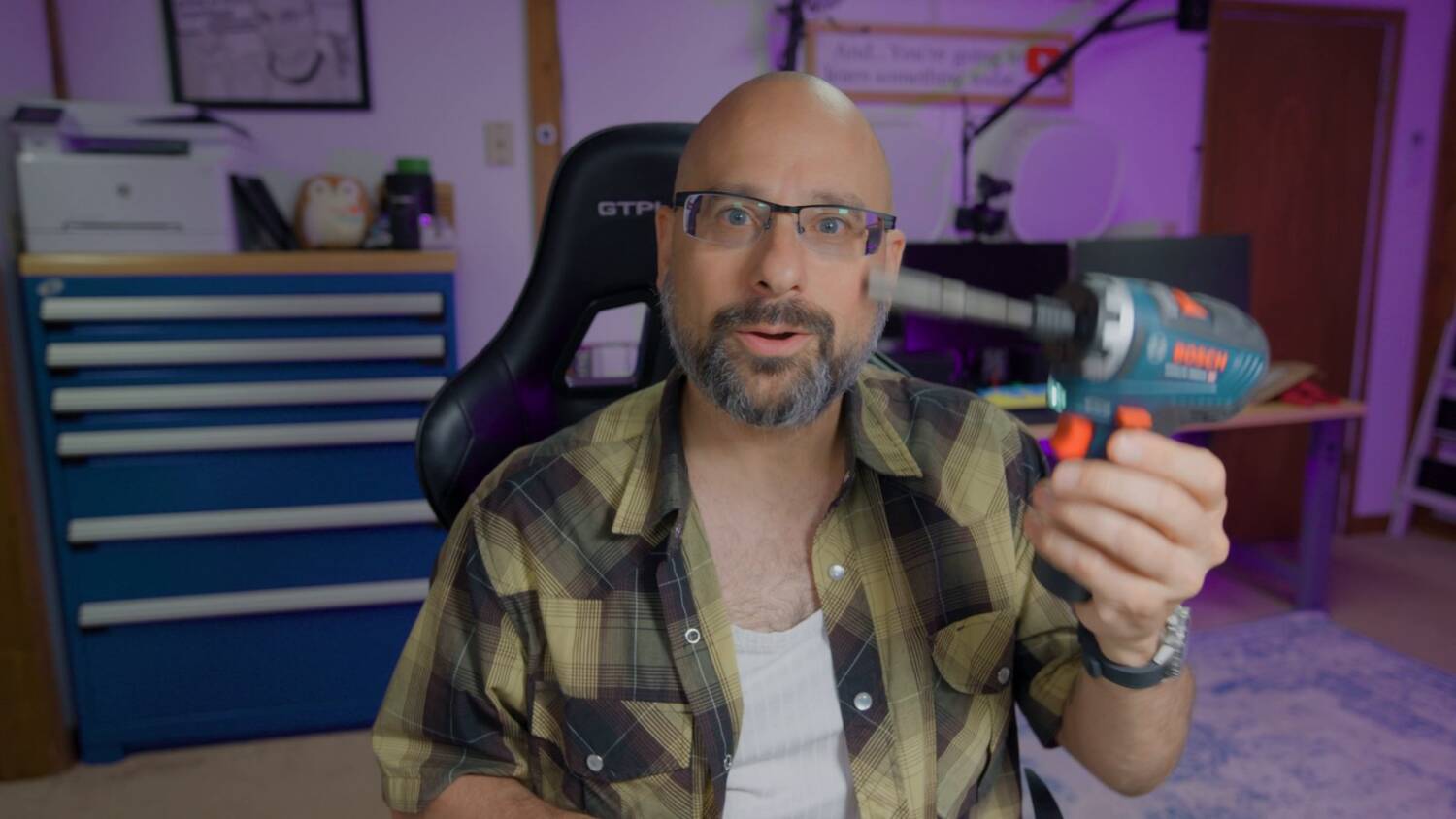
Ships with the Betaflight GPS bug
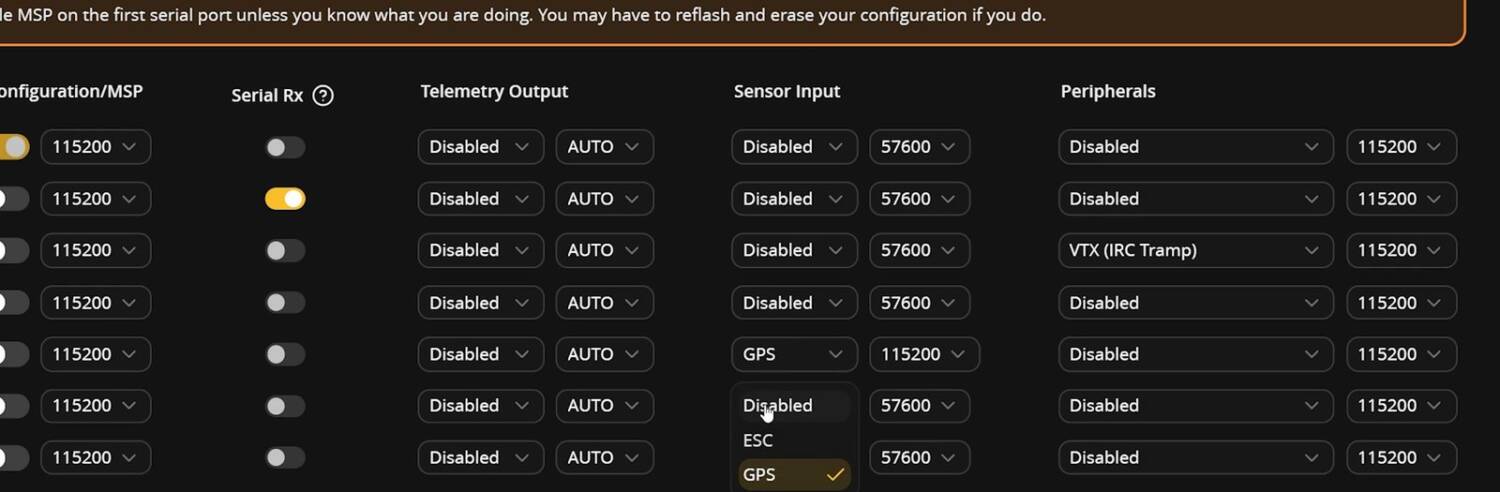
In the Configurator: as I suspected, it ships with Betaflight. And there’s one thing in this configuration that is an absolute deal breaker. It’s in the Ports tab. Sequre probably didn’t know about this, so I don’t blame them, but you need to know about it.
Betaflight has had a bug since about 3.1: if GPS is enabled in the Ports tab, but Betaflight can’t actually talk to a GPS (as here, because there’s no GPS on the drone), there’s a small chance that your flight controller just locks up mid-flight and falls out of the air. If you’ve experienced this, and people told you it must be bad hardware, now you might know why it happened. If you’re not running a GPS, change it to Disabled in the Ports tab and Save. That is an absolute must. (More in my video, Betaflight GPS bug crashes EVERY flight controller.)
Change the PID loop to 4K
Having done that, let’s look at how they ship the rest of the configuration. Obviously, we can set it up any way we want.
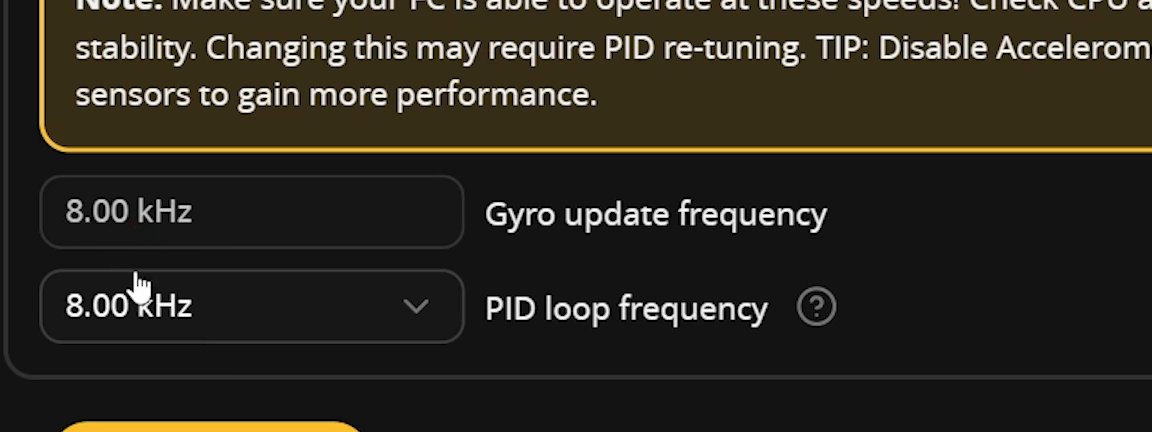
On the Configuration tab, the gyro update frequency is locked by the hardware, so you can’t change it. But they have the PID loop frequency set to 8K. Betaflight devs recommend running 8K/4K, even on fast processors like the H743. Especially if you’re running GPS, the Betaflight PID loop can get a little overwhelmed (more whelmed than it would like to be). 8K/8K is fine, but I’m setting it to 8K/4K, especially because I’m likely to add GPS on a drone like this. I haven’t, and I probably won’t, but I might.
Max arm angle 180 = good
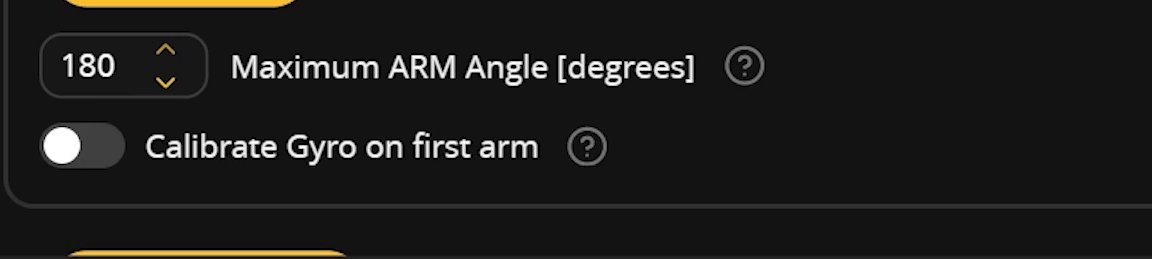
I’m very happy to see the maximum arm angle defaulted to 180. That means the drone can arm even if it’s not perfectly flat and level. I do that on all my drones. It’s a safety feature, but one I usually disable, because it’s annoying when you set your drone down on a hill or a rock and then it won’t arm.
The PID tune is basically defaults
The PID tune isn’t quite at the full Betaflight defaults. They’ve touched it, but not very much. Frankly, for a 10-inch I’d usually expect to see the PIDs deviate from defaults way more than this if it had been given a proper PID tune. So I wouldn’t say they’re shipping it with a good PID tune that they’ve really worked on. It seems pretty close to the defaults, which is fine. Betaflight defaults are pretty resilient, and it’ll probably fly fine.
Horizon mode = no
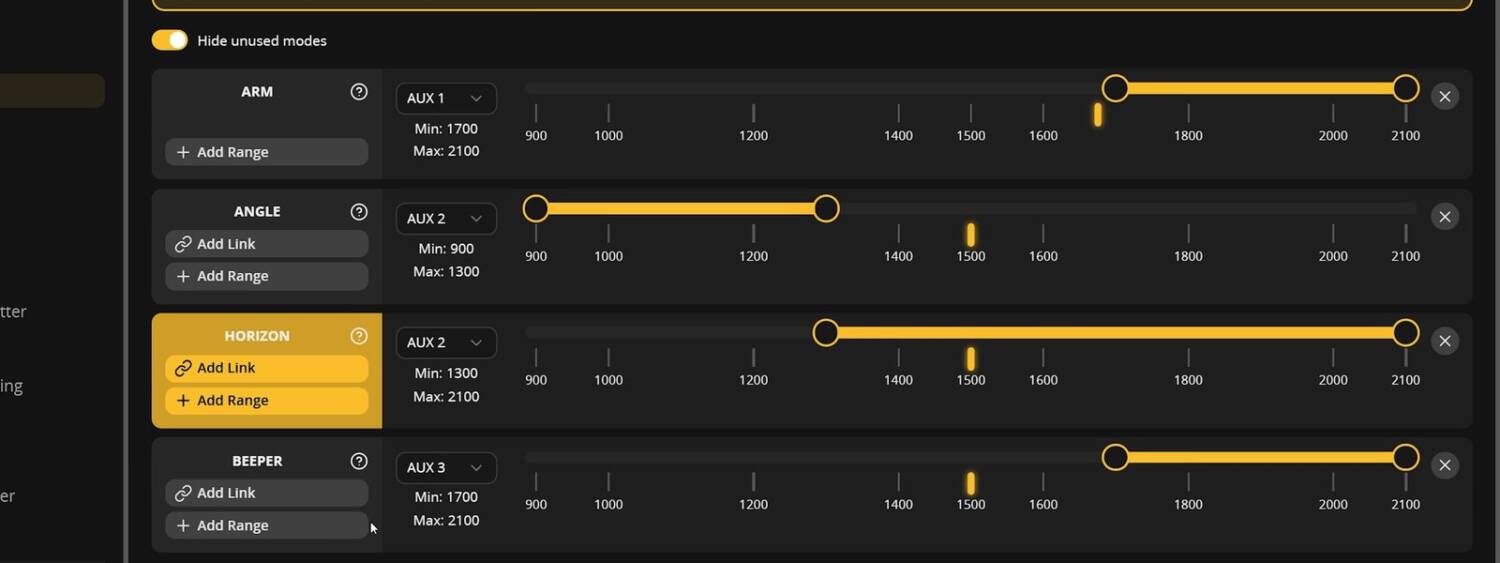
They ship it with some aux modes set up, but obviously you’ll bind your own controller and set up the aux modes yourself. However, I cannot forgive the sin of shipping it with Horizon mode enabled. No one should fly Horizon mode. Horizon mode is dead to me. Fly Angle mode if you need Angle mode, and fly Acro mode if you want to do acro stuff. But Horizon mode, forget about it. You’re dead to me.
Change DShot to 300
On the Motors tab, it’s set to DShot600. If we change the PID loop to 4K, we should change to DShot300: 600 goes with 8K, and 300 goes with 4K. It has to do with the timing of the signals. You don’t need to go into the math, but that’s how it ought to be.
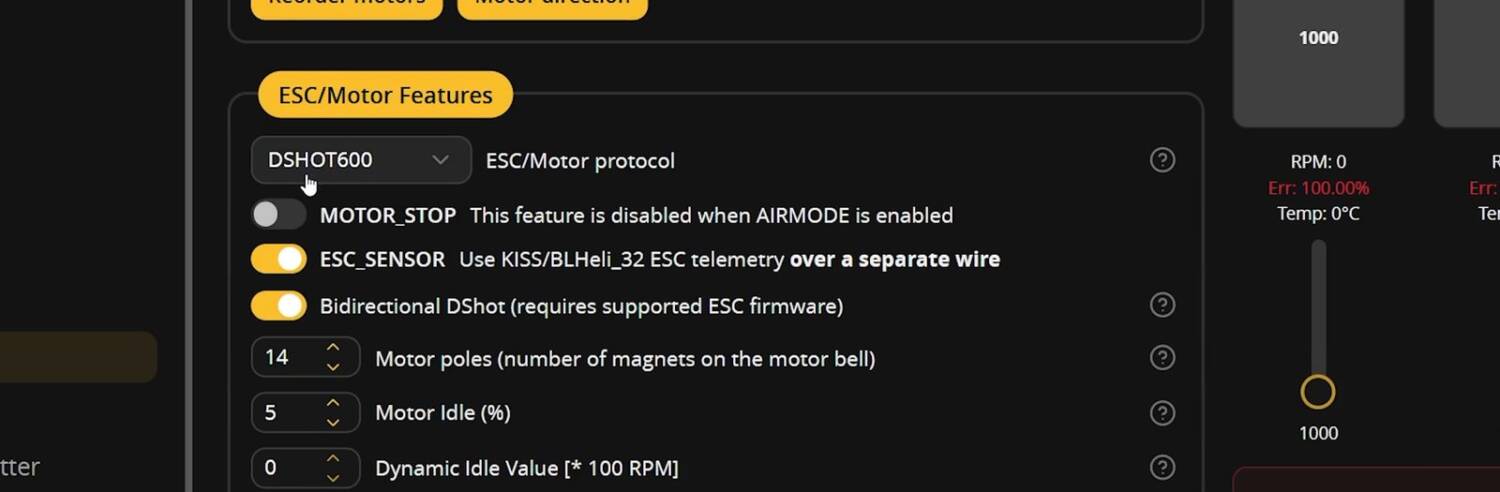
Betaflight 4.5.0?!
I guess I have to call this out: it looks like they’re shipping with Betaflight 4.5.0. There’s really no reason not to ship with 2025.12, which has significantly improved GPS, return to home and so forth. It has Position Hold and Altitude Hold in addition to return to home, and the return to home is significantly better. It’s been out for at least six months, more like nine. So there’s no reason Sequre shouldn’t have upgraded.
The camera is “muddy”
Out in the field, the camera isn’t the best. I can’t tell if it’s slightly out of focus. I don’t think it is. The details are a little muddy. The exposure is okay, though. There are just sort of blotches of green. Yes, analog’s not the best at that, but I’ve had analog cameras that were better.
Then I wondered: is it a 16:9 camera? A widescreen camera? It’s not the first time I’ve made this mistake. What you look for is whether the aspect ratio is wrong: when you do roll moves, stuff gets thinner and fatter.
The analog camera is 16:9
No, it’s a 16:9 camera. Isn’t that interesting? It’s a widescreen camera. Setting the goggles to match looks better, but it doesn’t change the detail we are or aren’t seeing. I don’t think it’s the best analog camera I’ve ever used, but it’s not the worst either. The exposure does a pretty good job. I’m not getting blown-out highlights or shadows that disappear into the dark.
How does she fly? I didn’t go too bonkers, because the battery isn’t a high-powered battery. It’s made for efficiency and long flight time. But I pushed it a little.
More aggressive flight test
This thing could go for a long time. They advertise something like a 45 minute flight time, and I believe it. Good, predictable throttle, with no weirdness or surprises coming out of a dive. I had one close call that it handled real well. I was glad I didn’t break a prop.
It got real bobbly through one section. We might be able to tune that better, but it’s a 10-inch. What do you want? The camera field of view seemed a little narrower than I might normally expect. And she corners like a 10-inch. It’s a different feeling when you’re freestyling a 10-inch: the consequences of a crash are much more severe.
Those motors sound good. But as soon as I get off the throttle and go upside down, there are a lot of bobbles. And look how muddy the image is. Not blurry like out of focus, just muddy. I think the camera’s not the best. It’s all one blob.
Complete video dropout
Then: lost video. The video completely dropped out in flight, and there was no way I was going to turtle mode it. I had to go get it out of a tree. (I’m going to need a thorough tick check after this.)
It was weird. I was chasing it down by the beeper, trying to figure out where it was while I tramped through the woods. Then it stopped responding to the beeper. I tried to arm, and nothing happened. I tried turtle mode, and nothing happened. The receiver still showed it was connected, and I still had telemetry. Then it started beeping, and I thought maybe it had rebooted. Back on the bench, everything looked completely normal. The video just randomly cut out in flight, and came back after I disarmed.
What do you do with that? Do you write off the whole flight controller because one weird thing happened? God forbid it happened while flying near something that mattered. There’s a part of me that wants to write this thing off, because if the vTX cuts out in flight, that’s obviously a deal breaker. And there’s a part of me that says that’s not fair. What if it was a fluke? A lot of people who do long range really love these, and Sequre generally has a pretty good reputation for building good hardware.
So I put a GPS on it, so I’d have Position Hold and return to home in case I lost video while flying, and it wouldn’t just crash. I updated it to Betaflight 2026.6 (or maybe 2025.12, I don’t remember), because that gives you good GPS Rescue return to home. Then I beat on it a little to see if I could get it to repeat the fault. There’s no GoPro on it for this part, because I had to mount the GPS up front. Mounting it in the back put it too close to the video transmitter. (And sorry about my neighbors mowing. What are you going to do?)
The first thing I did was bounce it on the ground a little. That makes the motors surge and causes physical shock to the system. If there’s a loose wire or something wrong with the voltage regulator, that can sometimes bring the problem out. I didn’t think it would, because I was just flying in a straight line when it happened the first time.
Trying to reproduce the vTX dropout
Nope. Nothing. That’s clearly not the problem. I don’t know. I guess I just have to fly a pack and see if it happens.
Then Position Hold. It said Heading N/A at first, and I had to get rid of that first: you have to fly a little bit before Betaflight will do Position Hold.
Position Hold and RTH test
It looks pretty radical from the FPV view as it tilts back, but it holds position pretty well. It’s locked in. It’s pretty locked in. So I guess I can trust it. I just kept my finger sort of on it.
Maybe I shouldn’t fly so aggressively if I’m expecting the video transmitter might crap out on me. But I’m not going to just be bored and hover. I’d also rather not have to retrieve it from a tree again, though. Nobody ever said I had good judgment. Did anybody ever say that?
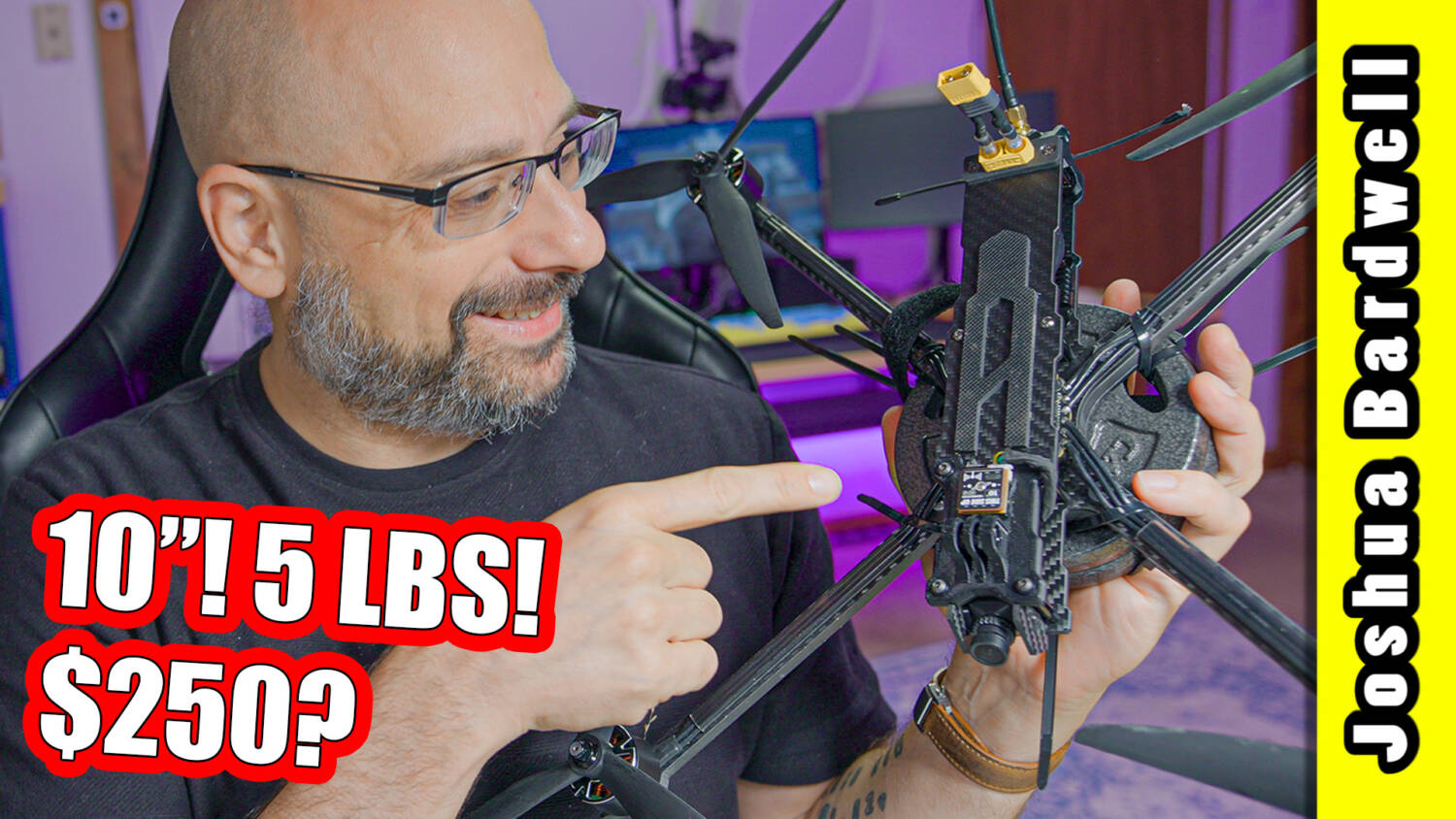
I had a lot of fun ripping this drone around. But one of the points of a bigger drone like a 10-inch is that it can carry weight. So I strapped two 2.5 lb weight plates to the bottom: 5 pounds together. I feel like that’s a pretty reasonable amount of weight for a drone like this to carry.
Adding 5 lbs of weight
The battery for this test is a 3500mAh 6S LiPo, starting at 3.97 volts per cell, so not fully charged. I used a LiPo because I thought we’d pull enough current that Li-ion wouldn’t be happy. (Don’t pay too much attention to the ammeter on the OSD. It isn’t calibrated correctly, and I did the math later to get the actual number. But we can look at the voltage sag.)
Getting in the air: woof. She’s angry now. But she hovers at 35% throttle carrying 5 pounds, with the voltage going from 3.9 to 3.75. She may fly better with the weight on, honestly.
Down to 3.6. This is a lithium polymer, so I can’t go below 3.0. The battery is unhappy. I might like a larger battery, to get more amps out of it more so than capacity. She’s fighting. She’s slidy through the turns with that weight. I had to get on the throttle, but I was trying not to, because I didn’t want to bottom out the battery. Still, that’s 5 lbs of weight. Not bad for 5 pounds.
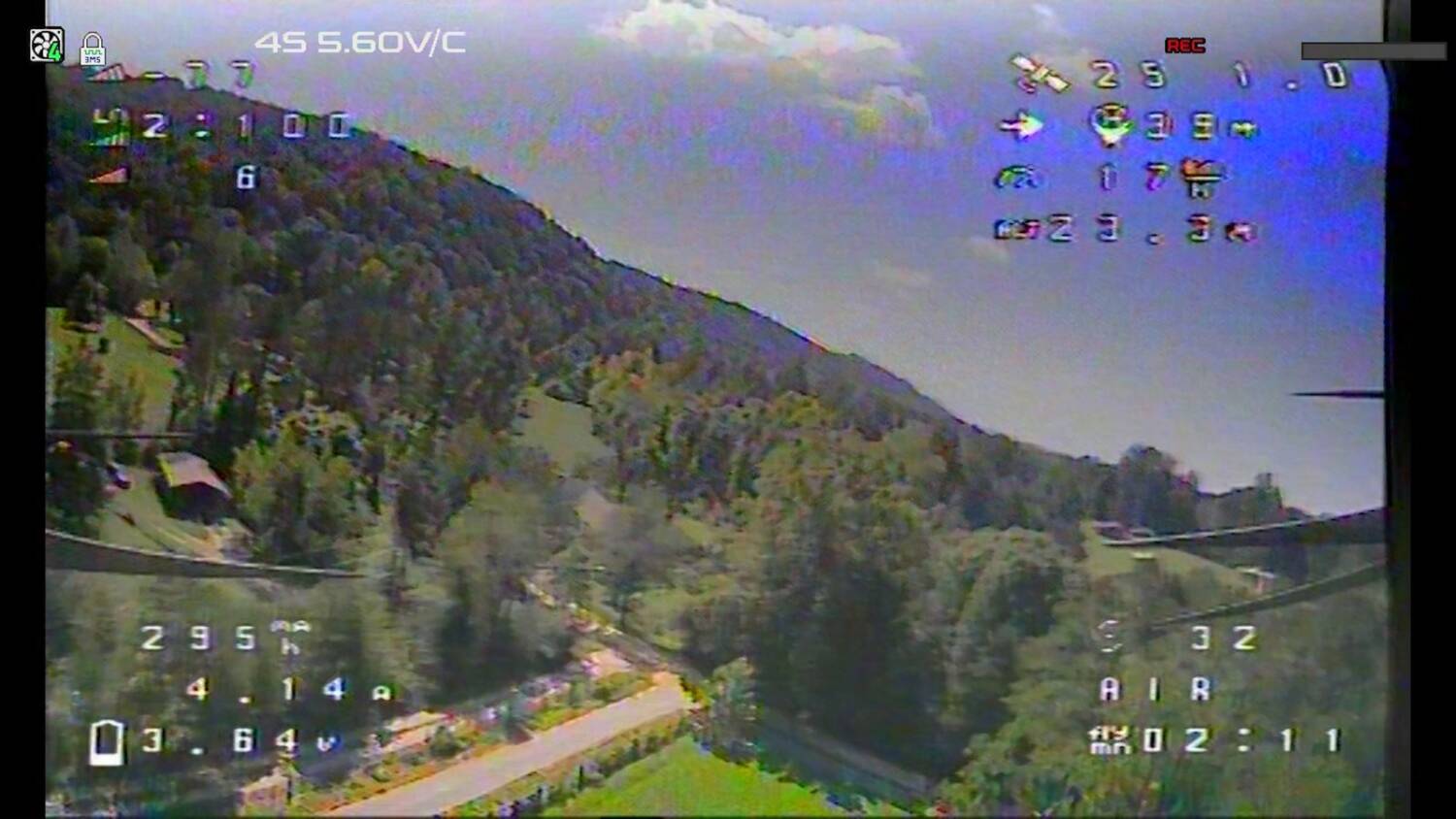
No, she’s not happy. I couldn’t do very much of this without hurting the battery. She’s a thick boy. Nothing like just zip-tying a couple of 2.5 lb plates on there.
Should you buy it? Probably yes.
All silliness aside: should you buy it? Yes. If you’re looking for a 10-inch drone, I don’t have many hesitations about saying this is a pretty insane value for money at whatever $250-ish price it is. (I didn’t pay for it. I was going to buy it, then I reached out to Sequre and asked if they’d send it to me, because why spend the money if I don’t have to? Thank you, Sequre.)
It’s not perfect. Let’s talk about the good. The build quality is really good. Nothing fancy, nothing over the top, just getting her done with a nice solid school-bus-style frame and good solder joints. No bells and whistles, but also no corners cut, is how I’d describe it. It’s right where you want to be. There’s lots of room inside for whatever additional stuff you want to put in.
I wish it came with a GPS. Frankly, I think there’s not much excuse for selling a 10-inch without one. Okay, some people will be using it in a part of the world where GPS is denied. But most people using a 10-inch are probably going to want a GPS on there.
The footage from the GoPro was pretty good. I thought I could see just a little bit of vibration when I spun the motors up, but I wasn’t using image stabilization, so that could probably improve it. I also didn’t have an ND filter on the GoPro. Put an ND filter on, like a cinematic pilot would, for a bit more motion blur, use stabilization, and I feel like you’d get more than acceptable results. That’s saying a lot, considering there’s no bracing on these arms or anything. It didn’t have a lot of weird vibration or jello. So if you wanted to use this cinematically, I think it has potential. Although you may have higher standards than I do.
Speaking of carrying weight: it’ll carry a GoPro without ever breaking a sweat. And if you wanted to carry a heavier camera, like a Red Komodo or whatever, I’m not sure I’d say it carried 5 lbs without breaking a sweat. It definitely was working. But hovering in the 35 to 40% throttle range with 5 lbs of weight is certainly usable. You just need to come up with the right battery to give you adequate flight time.
1 hour of flight time is fully achievable
Flight time: we’ve got to do the math on the current. When I finished the earlier flight, the DVR showed 697mAh used. (That includes the time it spent hanging in the tree, because the DVR was still recording.) When I recharged that battery, it took 2606mAh. We can use that for a rough calibration of the current sensor: 2606 divided by 697 is about 3.7.
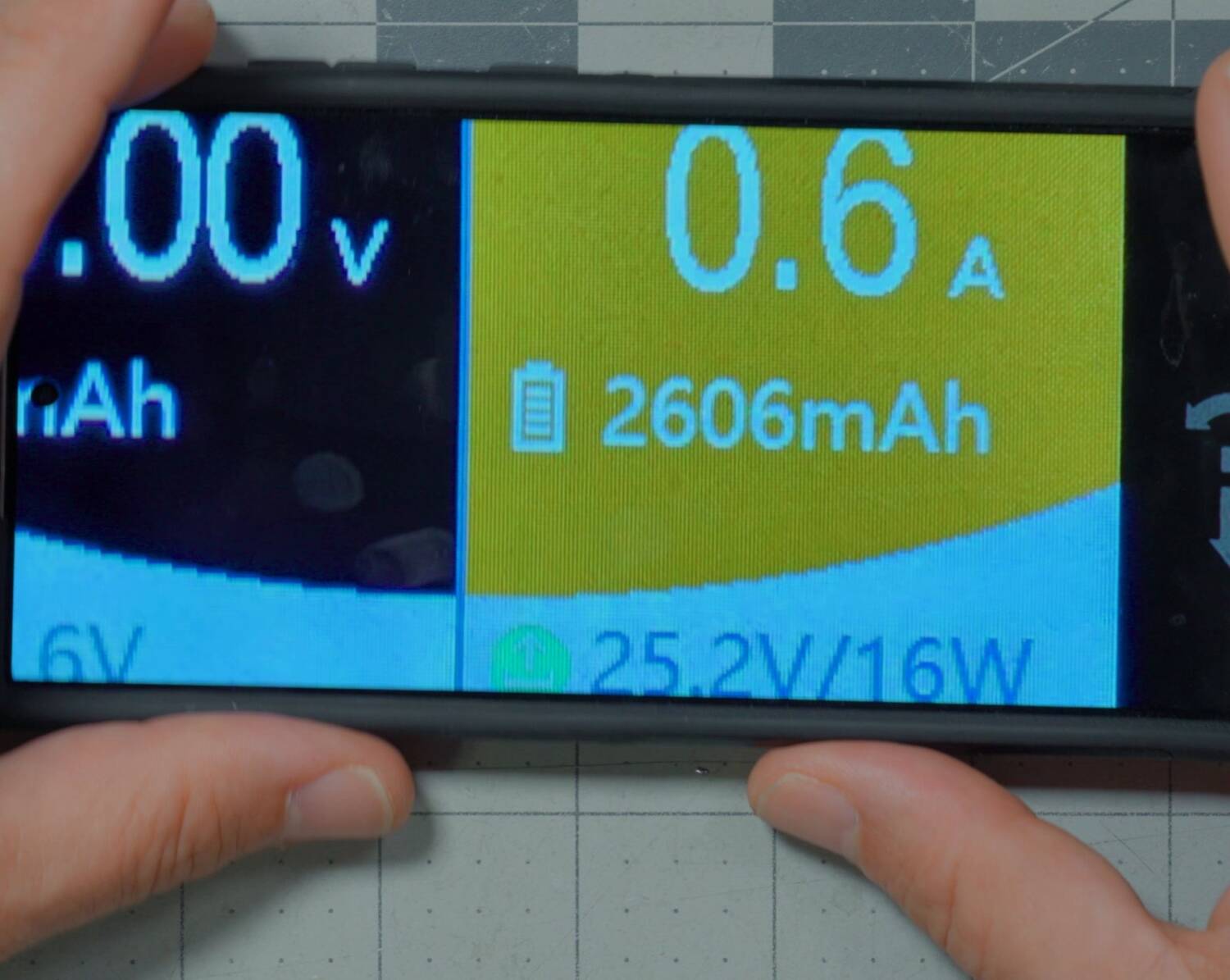
Going back to the footage, the OSD shows around 3 or 4 amps during normal cruise. Using a 4x multiplier so I can do it in my head, that’s around 15 or 16 amps. At the top of a power loop, punching out, it shows 15 amps, so that’s around 60 amps, at not full throttle. That’s without the weight. With the weights it was more, but it seems like a relatively efficient build.
Say we’re pulling 10 amps in cruise, conservatively. This Amprius battery is 10,000mAh, so we can fly for about an hour on it. Now, this is a pretty exceptional battery: 10,000mAh in a battery this small. It’s a very expensive battery, $500 or maybe more. But you can do the math for your own battery: roughly 10 amps in cruise, take your battery’s milliamp hours, and you get the number of hours. That’s a lot of flight time. Maybe 20 minutes or so with the 5 lb weight. Still pretty freaking good.
I’m trying to think of anything else I didn’t like. Oh, right: the vTX just turned off in mid-flight. If it’s a deal breaker for you that that happened at all, don’t buy it.
The vTX: you decide
But here’s the thing. You know this if you’ve done this for a long time: every drone you buy, you roll the dice that you’re going to get some gremlin. I feel like there’s enough about this one that we know is good that if we reject it just for the presence of one gremlin, now we’ve got the devil we don’t know instead of the devil we do. That shouldn’t have happened, and I’m not making excuses for it.
But given the price, given everything else that’s right about it, and given that I couldn’t reproduce it (although it’s going to happen again at the worst possible time), here’s what I’d do if I ran this as my daily. Either fly the crap out of it and try to figure out why it happened, or maybe convince myself it wasn’t going to happen again. Or move the vTX power off the flight controller directly to the ESC, so it’s powered from VBAT. My guess is that something about the flight controller caused the vTX to brown out. Unless the vTX itself was the thing that cut out, that fixes it.
The flight controller doesn’t have a vTX power switch, by the way. That’s another thing I’d change if I could wave my magic wand. The ability to turn the vTX off on something like this is very desirable. You can always add a switch as its own independent board, but it’s nice when it’s built into the flight controller.
And the output power of the vTX was somewhat less than advertised. Again, that’s based on my not-very-accurate meter, but it was far enough off that I feel comfortable saying, even with the inaccuracy of the meter, that it’s not making the power you’d want. It still makes some output power. And of all the things you could upgrade, just take that vTX and swap in another one. You spend another 20 or 30 bucks, and you probably still feel like you came out ahead.
If the vTX cutting out randomly isn’t a deal breaker for you, the link to buy it is at the top of this article. It’s not an affiliate link this time. I don’t have a Sequre affiliate. There’s also an 8-inch version, if 10 inches is a little bigger than you need. It’s basically the same thing, and I expect everything I’ve said about this one will hold true for that one.
The full review, with the flight tests and the 5 lb payload, is on my YouTube channel.